With that said, this is not an easy feat. Residents, community groups, local businesses, and District leaders all have different mandates, goals, and barriers, resulting in a diverse set of perspectives, objectives, and solutions to the community development issues plaguing DC. The key to success is to work through those differences to find the alignments, and that’s where organizations like The Coalition come in. We serve as the bridge, connecting the people who are most directly impacted by public policy with the decision-makers who shape it. At The Coalition, our advocacy approach isn’t just about pushing from the outside. It’s about helping communities step inside, with the tools, context, and confidence to make their voices heard and their solutions count.
 Take our groundbreaking Housing for All campaign as an example.
What started in 2010 as a modest campaign to elevate housing issues in the District quickly grew into a sustained movement powered by resident voice, coalition partnership, and government collaboration.
In just six years, the Housing for All campaign mobilized more than 4,000 supporters, aligned more than 100 organizations, and built constructive relationships with public officials. The campaign hosted annual rallies that swelled from 250 attendees to more than 700 passionate advocates throughout its lifespan. Through sustained community advocacy, the campaign secured historic wins, including a $100 million annual investment in the Housing Production Trust Fund, $26 million in housing vouchers, and a stronger public and political commitment to ending chronic homelessness in DC.
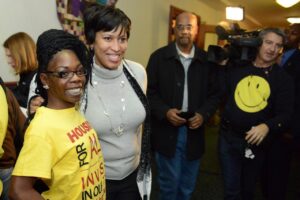
These wins were not the result of louder protests or better talking points alone. They were the outcome of long-term relationship-building. The outcome of showing up consistently. The outcome of listening closely. And the outcome of offering solutions grounded in real-life experience.
Since the conclusion of the Housing for All campaign, The Coalition has continued to take this approach across all our work. Through our Community Voices Academy—now proudly admitting its fourth cohort—and our newly established Resident Engagement Network, allowing us to cultivate deep relationships with residents whose experiences illuminate the path toward systemic reform. Our approach starts at the grassroots level, capturing insights from lived experiences to inform policy discussions across our eight dedicated working groups. Utilizing a consensus-driven model, we translate these insights into cohesive advocacy strategies, ensuring that community voices resonate powerfully in policymaking spaces.
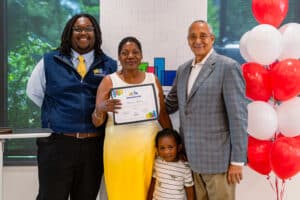 If the last several years have shown us anything, it’s that public engagement needs to evolve. Achieving meaningful representation requires ongoing investment in resources that empower practitioners, staff, and community stakeholders with the knowledge and skills essential for effective advocacy. In our current landscape, mobilization efforts must evolve beyond traditional methods, embracing creativity to inspire and engage diverse audiences. From incorporating storytelling and visuals to more accessible educational forums, we must bring new voices into the conversation and help diverse audiences connect with the issues. This kind of advocacy is not just about influencing decisions. It’s about transforming the relationship between government and community, turning a process that often feels closed and reactive into one that is transparent and generative.
Communities are not just stakeholders in the outcomes of policy. They are partners in the work of shaping it. When organizations like ours help bridge that gap, big change becomes not only possible, but sustainable.
This moment requires more than capturing attention. It requires us to transform participation into meaningful systemic change.
 By Lamar Richards, Senior Director of Advocacy and Community Engagement